Heat Pumps

R32 and R454B

An A2L or A3 refrigerant brings a charge limit with it, and that limit is a hard ceiling on what the machine can contain. Every liter of internal volume in the evaporator and condenser is charge that has to be counted.

AsyMatrix construction claims up to 30 percent lower hold-up volume than a symmetric equivalent, which translates directly into headroom under the charge limit - or into a larger machine at the same limit.

R32 and R454B. are served by the 190 range - D190 dual circuit, FI190 and PI190 single circuit - covering 60 to 150 kW and working as evaporator or condenser.

R290 propane. has a GWP of 3 and standard brazed frames suit it. The constraint is not material compatibility but charge, and therefore internal volume.

Reversible operation. asks one exchanger to be an evaporator in one mode and a condenser in the other. Hypertwain adds ancillary ports so the unit is optimized in both directions rather than compromised in one.
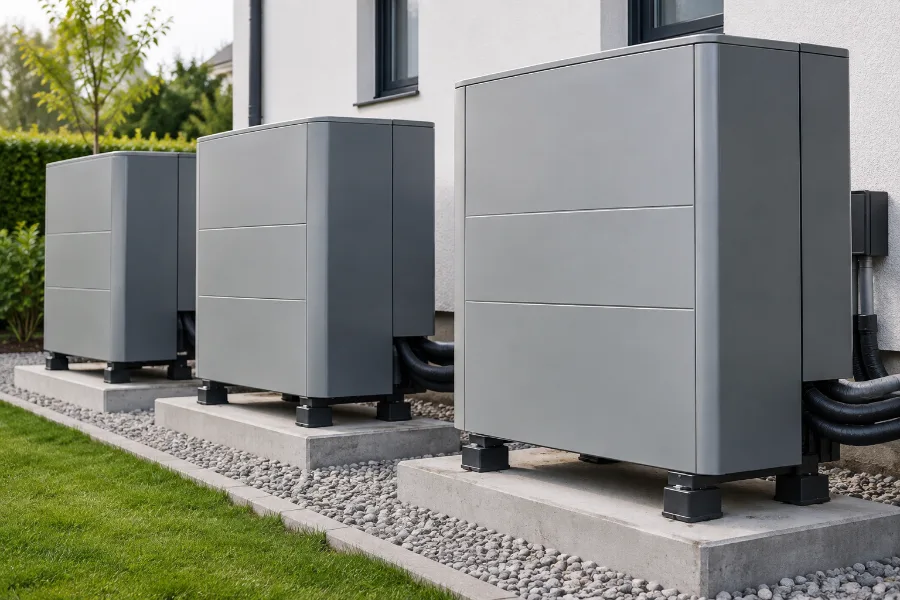

heat pumps with SWEP brazed plate heat exchangers
Evaporator Duty Evaporator Duty
Condenser Duty Condenser Duty

Refrigerant Charge Refrigerant Charge

Reversing Systems Reversing Systems

Heat Pumps Selection

What decides the frame, and what to send with the enquiry.

Duty Inputs

  • Flows: both sides
  • Temperatures: in and out
  • Fluids: named, not described
  • Pressure drop: what is affordable

Typical Frames

Watch Items

  • Send the duty for a check
REFRIGERANT GWP WHAT IT DRIVES
R410A 2,088 M pressure class, 45 bar at 135 C, fatigue tested
R32 675 190 range, integrated distribution
R454B Lower still 190 range
R290 propane 3 Charge limit - minimize hold-up volume

Why hold-up volume became a specification

Ten years ago nobody selecting a heat pump exchanger asked what its channel volume was.

The reason is regulatory rather than thermal. Charge limits for flammable refrigerants are absolute, and they are assessed on the whole circuit. An exchanger that holds half a liter more than it needs to is half a liter of charge that cannot be spent on a bigger compressor or a longer line run.

That is why the asymmetric frames matter here more than anywhere else in the range. Making the refrigerant channel smaller than the water channel reduces charge without reducing the water side's ability to move heat away, which is the trade a symmetric plate cannot make.

The practical consequence for a selection: give us the refrigerant and the charge budget, not just the duty. A frame that meets the duty and busts the charge limit is not a selection.


Frames for This Duty


SWEP FI190 brazed plate heat exchanger - part of the 190 range, designed around r32, r454b and r290
SWEP B250AS brazed plate heat exchanger - asymatrix in the h pressure class - 45 bar at 155 c
SWEP B26 brazed plate heat exchanger - asymmetric channels - two different channel volumes in one pack

Before You Specify

Freezing on the water side. If water flow drops while the compressor keeps running, the refrigerant pulls the plate below freezing, ice forms in the channels and the pack splits. The first sign is usually water in the refrigerant circuit, by which time the compressor is at risk as well.

The causes are ordinary: a blocked strainer, a failed pump, a flow switch left bypassed after commissioning, or a defrost cycle on a reversible unit with too little water volume behind it. Prove flow before the compressor starts and keep the strainer clear. Freeze protection covers the control side.

Only one of them can have it. The water direction is fixed by the piping, and the refrigerant reverses when the machine changes mode, so an exchanger that is counter-current in heating is co-current in cooling.

Decide deliberately which mode gets the better arrangement. It normally goes to the mode that sets the machine's rated performance or has the tightest approach. The mistake is piping the water side whichever way is convenient and finding the shortfall at the first capacity test. Mount the unit vertically in either case, as any two-phase duty requires.

Check it at minimum compressor speed as well as at full load. At low speed the refrigerant mass flow is a fraction of the design figure, and a pack with many channels can no longer share it evenly. Some channels run flooded and some dry, and superheat control hunts.

This is where a generous plate count works against the machine. A selection that looks comfortable at full load may be the one that misbehaves for most of the operating hours, since a heat pump spends the season at part load. Send the turndown range along with the design duty.

It will fit the brackets and the pipework, and that is the trap. B80, F80, P80 and V80 share dimensions, but they differ in the distribution device at the refrigerant inlet. Fit the wrong one and the machine runs with poor distribution, unstable superheat and reduced capacity, with nothing visibly wrong.

Order by the complete nameplate string, starting with the family letter. Plate type, plate count, pressure class and connections all need to match the original as well. If the nameplate is unreadable, send the heat pump make and model and the refrigerant.

It follows the refrigerant. R410A work is the M class, published as up to 45 bar at 135 C and fatigue tested, which matters because a heat pump cycles pressure every time it starts, stops, defrosts or reverses. A CO2 machine is a different order of pressure and needs the U class, 64 to 140 bar.

Two cautions. The class letter is a category and not the stamped rating of a given unit, so check the build against the machine's design pressure on the high side. And for UL approval on CO2 duty, allow for a relief valve on each side set at 0.9 times design pressure.

Thermally yes, but it brings in potable rules. With refrigerant and oil on one side of a single plate and drinking water on the other, many codes require double-wall construction, where two plates are brazed together so a leak vents to atmosphere and becomes visible instead of crossing into the water.

Check the temperture as well. NSF/ANSI 61 is limited to 90 C, and discharge gas entering a desuperheater is hotter than the water it heats. The usual alternative is an intermediate water loop feeding a separate potable exchanger. Double-wall separation explains the options.

Quote Request Form:

Questions?

1-805-484-2992

Quotes - Engineering - Sales