
1-805-484-2992
Quotes - Engineering - SalesINSTALLATION AND SERVICE
Freeze Protection
Water expands when it freezes and a brazed pack has nowhere to put that expansion. The plates split, the circuits mix, and the unit is scrap.
The protection is not complicated and it is worth fitting completely rather than partially: a filter, antifreeze where the temperatures warrant it, a freeze thermostat, and a flow switch.
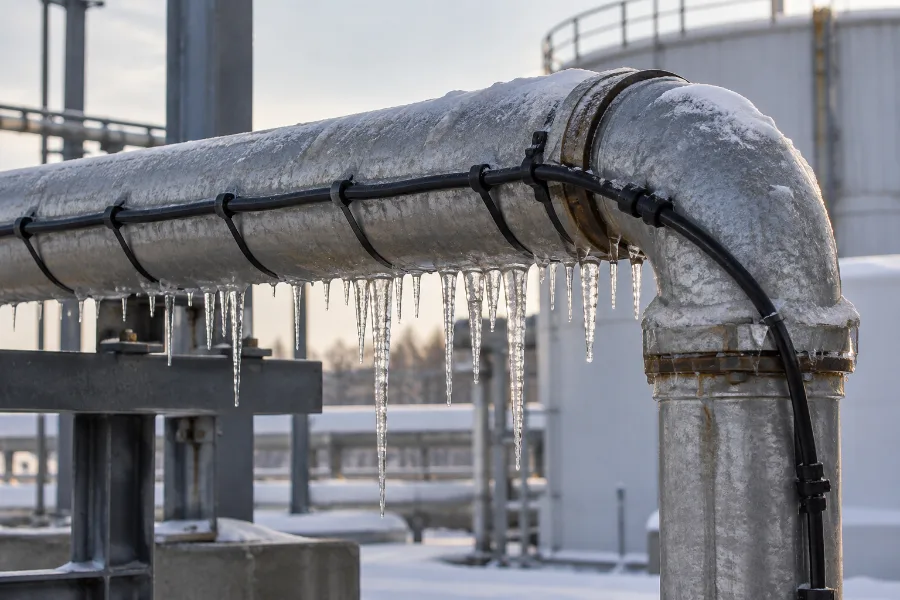
The combination of strainer, antifreeze, freeze thermostat and flow switch that keeps water from freezing in the channels of a brazed plate evaporator, where ice splits the plates and the unit cannot be repaired.
| MEASURE | PROTECTS AGAINST | NOTE |
| Filter below 1 mm | Blockage causing flow loss | 16 mesh |
| Antifreeze | Low evaporating temperature | Where it nears the freezing point |
| Freeze thermostat | The resulting temperature | Backstop |
| Flow switch | The cause - loss of flow | The primary protection |
On the Bench and In the Line
Filter Below 1 Mm, 16 Mesh
Filter below 1 mm, 16 mesh - a blockage is what causes the flow loss that causes the freeze.
Antifreeze
Antifreeze - wherever the evaporating temperature approaches the water-side freezing point.
Loss of flow, not low temperature, is what freezes an evaporator
An evaporator running at design flow does not freeze, even at a low evaporating temperature, because the water is moving fast enough to carry heat to the plate surface. What freezes it is flow falling away while the compressor keeps running - a blocked strainer, a failed pump, a closed valve.
A freeze thermostat responds to the temperature that results, which means it acts after the conditions for freezing already exist. A flow switch responds to the cause, which means it can stop the compressor before the plate surface ever gets there.
Fit both. The thermostat is the backstop; the flow switch is the protection.
Details That Decide It
Almost always because the switch was not effectively in the compressor safety chain at the moment flow was lost. The common versions: a jumper left across it after commissioning, a paddle stuck by debris, a trip point set so low that a trickle satisfies it, or a control sequence that lets the compressor pump down after the water pump has stopped.
Pump-down is the one that surprises people. Evaporating pressure falls as the refrigerant is drawn out, the plate surface gets colder than it ever does in normal running, and the water in the channels is standing still. Keep the pump running until the compressor has stopped, and prove the interlock by closing a valve during commissioning.
It does, in both directions. A generous plate count does the duty with a smaller temperature difference, so the evaporating temperature sits closer to the leaving water temperature and further from the freezing point. That is real margin.
Overdo it and the water velocity in each channel drops, particularly at part load on a variable-flow system, and slow channels are the first to ice when something else goes wrong. State the minimum water flow as well as the design flow when an evaporator is being selected, so the frame is checked at both.
Find out why the flow stopped, or the new unit fails the same way. Pull the strainer, clean it, and confirm it is the 16 mesh, below 1 mm filter this duty calls for. Check the pump and its controls, then trip the flow switch and the freeze thermostat deliberately to prove each one stops the compressor.
Then deal with the refrigerant circuit. A split plate lets water into the refrigerant side, so the system is wet: expect to change the driers and the oil and to evacuate thoroughly before charging. Skipping this leaves moisture in a system with a new exchanger and an old compressor.
Look at the pack and at both circuits. Ice pushes the plates apart, so a frozen unit often shows a bulged cover plate or a pack that has grown in thickness. The circuits tell the rest: refrigerant charge disappearing with no external leak, the water loop gaining pressure or venting gas, and water turning up in the refrigerant side.
A fatigue or corrosion leak does not deform the pack.
Not reliably. The channels of a brazed pack are narrow and corrugated, and water stays trapped in them after the drain valve runs dry. That residue is enough to split plates when it freezes, and the damage is only found when the system is refilled.
For a unit that will sit in freezing conditions, either blow the water side out with dry air until nothing more comes out, or circulate an antifreeze mix through it before shutdown. The same applies to water-cooled condensers, and to a unit that was pressure tested with water and then left in an unheated space before installation.
Set the concentration against the coldest plate surface the evaporator can produce, which follows the evaporating temperature, not the leaving water temperature. A mix chosen only to protect outdoor pipework against winter air can still freeze on the plate.
The field problem is dilution. Loops are topped up with plain water after a leak or a service visit, and the concentration drifts down year by year without anyone recording it. Test it at every service. And give the type and concentration whenever a unit is sized, because glycol changes both capacity and pressure drop.
Related

SERIES • 18 TO 75 GPM
SWEP B26
Asymmetric channels - two different channel volumes in one pack.
+ Learn More
SERIES • 200 TO 400 GPM
SWEP B250AS
AsyMatrix in the H pressure class - 45 bar at 155 C.
+ Learn More
RELATED
Cleaning in Place
A brazed unit cannot be opened, so everything about keeping it working comes down to two things: keeping solids out, and cleaning in place before.
+ Learn More