
1-805-484-2992
Quotes - Engineering - SalesINSTALLATION AND SERVICE
Mounting
and
Piping
In two-phase applications - evaporators and condensers - units mount vertically, with the arrow on the front plate pointing upwards. This is not a preference. A horizontally mounted evaporator traps liquid in the lower channels and starves the upper ones.
Single-phase liquid-to-liquid duty is more forgiving, but vertical mounting still helps venting.
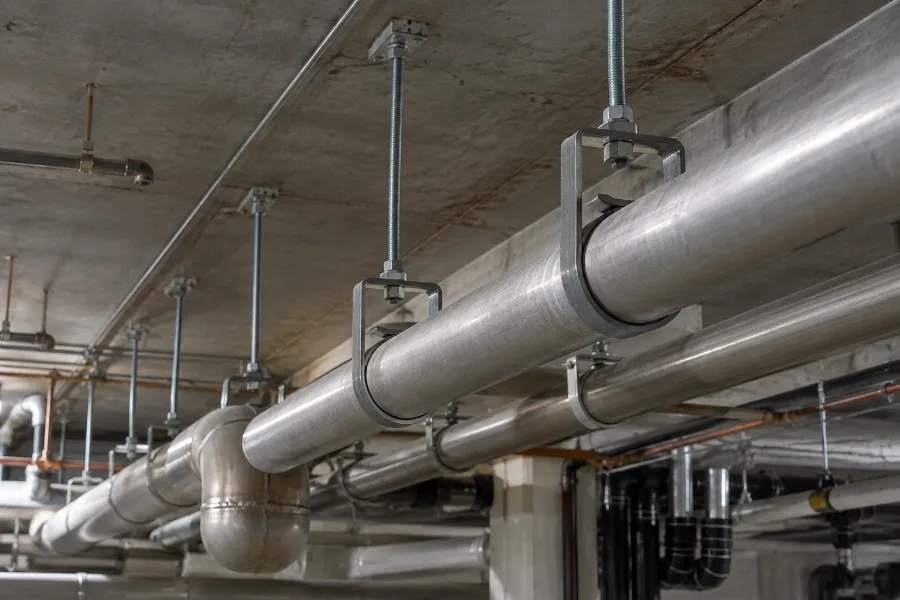
A hookup in which the two fluids pass through the plate pack in opposite directions, so each one leaves beside the other's inlet. It gives the closest approach a given plate count can reach.
| ITEM | SPECIFICATION |
| Orientation, two-phase | Vertical, arrow pointing up |
| Condenser gas inlet | Upper left, F1 |
| Condenser condensate outlet | Lower left, F3 |
| Flow direction | Counter-current |
| Soft soldering | Min 45% silver, max 450 C |
| Hard soldering | 450 to 800 C |
| Storage beyond two weeks | Between 1 C and 50 C |
On the Bench and In the Line
Ports Are Numbered F1 to F4 Front, P1 to P4 Back
Ports are numbered F1 to F4 front, P1 to P4 back. - On B-series frames F1 to F4 are the outer circuit and F2 to F3 the inner.
Condenser:
Condenser: - gas in at the upper left (F1), condensate out at the lower left (F3).
Soldering, supports and the things that show up later
Soldering. Use a minimum 45 percent silver solder, at a maximum of 450 C for soft soldering or 450 to 800 C for hard soldering. Keep the flame moving and directed away from the plate pack. Overheating the braze at the port does not fail immediately - it fails later, under pressure, and looks like a manufacturing defect.
Support. Support legs and brackets are available across the range. On the larger frames the unit weight is more than pipework is designed to carry, and a pipe-supported installation puts a bending load on the connections that they were never intended to take.
Both are cheap at installation and expensive afterwards.
Mounting and Piping - Asked and Answered
Read the four port temperatures at steady load. Piped counter-current, each fluid leaves beside the other fluid's inlet, so the cold outlet can run warmer than the hot outlet. Piped co-current, both fluids leave at the same end and the cold outlet can never climb above the hot outlet, whatever the plate count.
The usual cause is assuming the direction of the second circuit from the first instead of reading the port markings. Catch it before the insulation goes on - afterward the only symptom is a duty that falls short, and the exchanger gets blamed for being too small.
Only if the whole designation matches, not just the model. Connections are listed in port order at the end of the designation, and two units with the same plate pack can carry different connection types and sizes, or have them on the back (P1 to P4) instead of the front (F1 to F4).
Two details catch people. A trailing T is a different plate generation, so a B25T is not a drop-in for a B25. And a different plate count changes the depth of the pack, which matters where the unit sits against a wall or inside a cabinet. Send the full nameplate text and a photo of the connection face; the Model Number Guide shows how to read each field.
Match each connection to the joining method the installer will use on that circuit, and settle it before ordering - it is part of the designation, not an accessory. Refrigerant circuits are normally soldered and water circuits threaded, which is why a designation such as B25THx30/1P-SC-M 16+22U+2x1"NPT mixes both on one unit.
A U connection is a universal solder socket that takes both imperial and metric pipe: 22U covers 7/8 in and 22 mm. That saves an adapter on a job where the pipe standard is uncertain. On water lines, remember that the port sets the flow capacity. Bushing a small port up to a larger pipe does not add any.
A heat sink and short torch time. Wrap a wet rag around the base of the connection, clean and degrease the joint, and heat the pipe end, letting the connection come up with it. Solder with at least 45 percent silver flows readily, which keeps the time under the flame short.
Purge with dry nitrogen while heating. Without it, oxide scale forms inside the line and ends up in the expansion valve or the compressor. If a connection has discolored well down toward the cover plate, treat the unit as suspect and pressure test it before charging.
Yes, wherever compressor pulsation or vibration can reach the unit through the pipe. A brazed pack is rigid, and the joint between connection and cover plate is where a cyclic load ends up. Fit vibration absorbers in the refrigerant lines, anchor the pipe independently of the exchanger, and give the unit its own bracket or feet.
The water side has its own version. Fast-closing solenoid or actuated valves cause water hammer, and repeated pressure spikes fatigue the braze joints. The failure appears months later as a leak at a port or between circuits, with nothing visibly wrong with the installation.
A strainer ahead of each water inlet, isolation valves on all four connections, and a pair of valved tees between the isolation valves and the unit. A brazed pack cannot be opened, so those tees are the only way to circulate cleaning solution through it later without cutting pipe.
Add temperature and pressure tappings at each port. Rising pressure drop at constant flow is the earliest sign of fouling, and without gauges nobody sees it until the duty has already dropped. The hookup itself is covered under Cleaning in Place.
Related
SERIES • 18 TO 75 GPM
SWEP B80
The 526 mm standard - and the plate shared by the F80, P80 and V80 evaporators.
+ Learn More
RELATED
Cleaning in Place
A brazed unit cannot be opened, so everything about keeping it working comes down to two things: keeping solids out, and cleaning in place before.
+ Learn More