Commercial Refrigeration

V-series

In an evaporator the refrigerant enters as a mixture of liquid and vapor. If that mixture is not split evenly between channels, some flood and some starve, and the effective surface collapses. You can lose a third of the capacity you paid for with no mechanical fault at all.

The distribution device at the inlet is what prevents this, and it is the reason a V80 and a B80 are different products despite identical plates, identical dimensions and identical channel volume.

V-series. for general duty across a wide capacity range.

P-series. optimized for R410A.

S-series. optimized for R134a at lower capacities.

F-series. for high-performance chiller and heat pump evaporator duty.
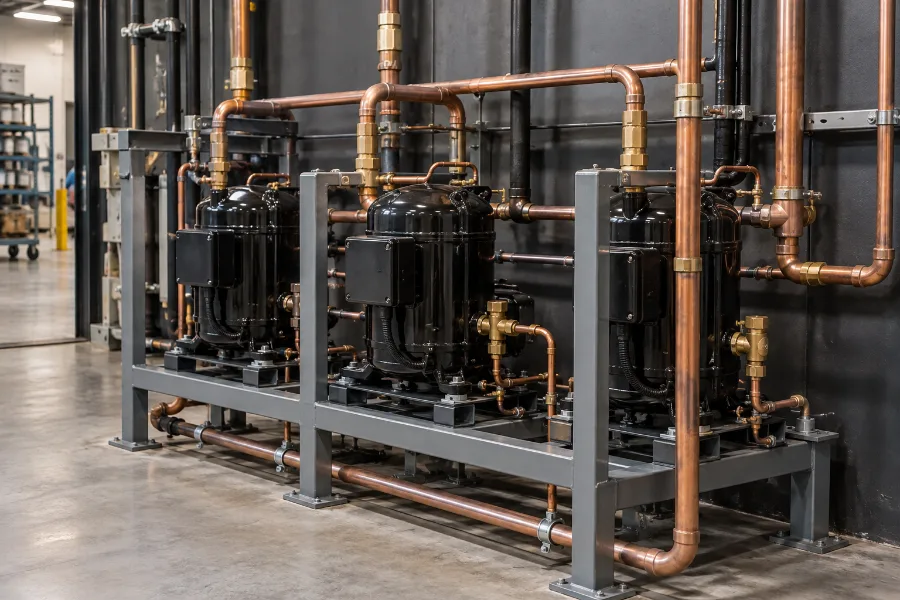
commercial refrigeration with SWEP brazed plate heat exchangers
Rack Systems Rack Systems
Evaporators Evaporators

Condensers Condensers

Defrost Cycles Defrost Cycles

Commercial Refrigeration Selection

What decides the frame, and what to send with the enquiry.

Duty Inputs

  • Flows: both sides
  • Temperatures: in and out
  • Fluids: named, not described
  • Pressure drop: what is affordable

Typical Frames

Watch Items

  • 190 range
  • Mount two-phase units vertically
ROLE SERIES KEY CONSTRAINT
Evaporator V, P, S, F, 190 range Even distribution; freeze protection
Condenser B-series, dual circuit Port order - gas upper left
Economizer V80, small B frames Subcooling target, not tonnage
Desuperheater B-series, double wall Braze temperature ceiling

The four roles, and what each one gets wrong

Most refrigeration exchanger problems are not sizing problems.

Evaporators fail on distribution and on freezing. Fit a filter below 1 mm, use antifreeze where the evaporating temperature approaches the water-side freezing point, and fit a freeze thermostat and flow switch. A brazed evaporator that freezes is not repairable.

Condensers fail on piping. Refrigerant gas enters the upper left connection and condensate leaves the lower left. Reversed, the pack floods and capacity disappears.

Economizers and desuperheaters mostly fail on temperature. Discharge gas can arrive hot enough to approach the copper braze ceiling of roughly 185 C - check the actual discharge temperature rather than assuming the pressure rating covers it.


Frames for This Duty


SWEP B26 brazed plate heat exchanger - asymmetric channels - two different channel volumes in one pack
SWEP B250AS brazed plate heat exchanger - asymatrix in the h pressure class - 45 bar at 155 c
SWEP B220 brazed plate heat exchanger - 296 plates in a 524 x 202 mm envelope - high surface density for the footprint

Commercial Refrigeration in Practice

Sometimes, but check two things before assuming so. The distribution device is matched to how a refrigerant behaves at the inlet, which is why the P-series is optimized for R410A and the S-series for R134a. An evaporator tuned for one can distribute poorly on another.

The second is pressure. A refrigerant that runs at higher pressure may be beyond the class of the unit that is installed. Read the class letter and the stamped limits off the nameplate and send them with the new refrigerant and operating conditions. Refrigerant Compatibility covers the pairings.

The cause. A frozen evaporator is a symptom of water flow that stopped or fell while refrigerant was still evaporating, and a new unit dropped into the same circuit meets the same end.

Before fitting the replacement, prove the flow switch actually trips the compressor, confirm the freeze thermostat setting, and look at what happens at shutdown: a pump that stops before the compressor has finished pumping down leaves cold refrigerant against still water. Check the strainer too. Debris that blocks a few channels starves them of water, and those are the channels that freeze first.

It depends on the refrigerant's operating and standstill pressures. As categories: S is 31 bar at 155 C and serves a wide variety of duties; M is up to 45 bar at 135 C and is fatigue tested, aimed at refrigerants such as R410A; H is 45 bar at 155 C, the class of the B250AS.

The fatigue testing matters on refrigeration more than the headline pressure. Compressors cycle, and every start and stop loads the braze joints again. These are class descriptions, not the stamped rating of a particular unit, so read the nameplate on a replacement. See Pressure Classes.

When two independent refrigerant circuits share one water stream - typically two compressors that stage. Each refrigerant circuit is interleaved through the whole pack, so with one compressor off, the running circuit still sees the full water flow across its plates and part-load performance holds up.

Two separate exchangers piped in parallel do not behave that way: half the water bypasses through an idle unit. The trade-off is at failure. A leak in either circuit condemns the whole dual unit, and both circuits are down for the change.

Because of what is on the other side. A desuperheater usually recovers heat into water that people will use, and a single-wall leak would put refrigerant and compressor oil into it without any sign. A double-wall plate vents a leak to atmosphere where it can be seen.

Two further points apply to this role. Discharge gas is the hottest stream in the system, so hard water scales the plates quickly and the copper braze ceiling of roughly 185 C has to be respected. And the unit should be sized to take the superheat only; allowing condensation in it upsets the condenser downstream.

Quote Request Form:

Questions?

1-805-484-2992

Quotes - Engineering - Sales