
1-805-484-2992
Quotes - Engineering - SalesSELECTING A UNIT
Approach Temperature
Tightening the approach means more surface, and more surface means more plates. The relationship is not linear: the last degree costs far more than the first, because each increment of surface works against a smaller temperature difference.
That is why it is worth deciding what approach a system actually needs rather than inheriting a number from a previous job.
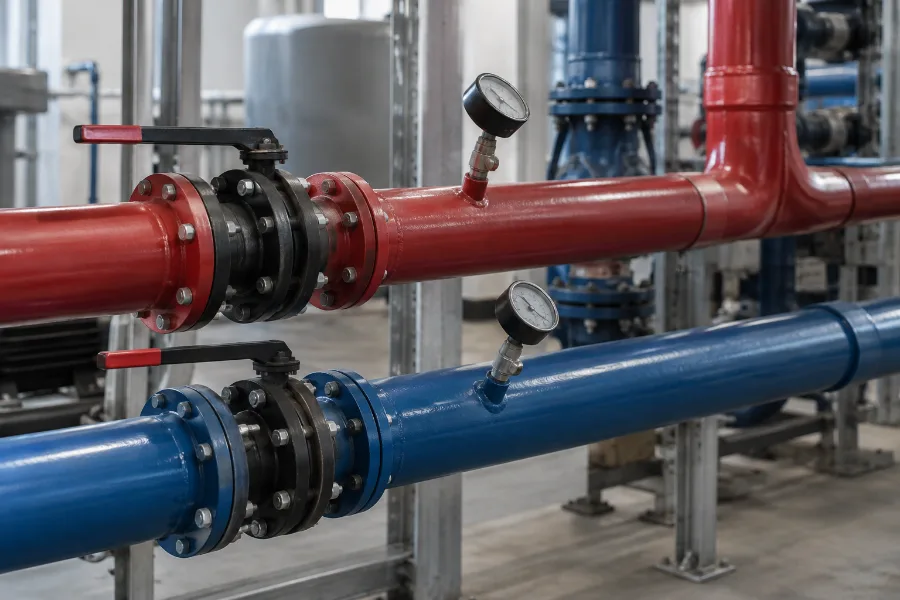
Going from 5 C to 4 C costs less than going from 3 C to 2 C, for the same one-degree gain.
Request a QuoteThe gap between the temperature one fluid leaves at and the temperature the other fluid enters at, measured at the same end of the exchanger. The smaller the gap, the more plate surface the duty takes.
| DUTY | APPROACH MATTERS | WHY |
| Heat recovery | A great deal | Directly proportional to energy captured |
| Free cooling | A great deal | Converts into annual operating hours |
| Boiler isolation | To a threshold | Condensing point of the boiler |
| Comfort heating | Little | Both loops are already close |
Getting the Number Right
The Last Degree is the Expensive One
The last degree is the expensive one. - Going from 5 C to 4 C costs less than going from 3 C to 2 C, for the same one-degree gain.
Counter-current Flow is Assumed
Counter-current flow is assumed. - Co-current piping puts a hard ceiling on the achievable approach whatever the plate count.
How to decide the number instead of inheriting it
On a heat recovery or free cooling duty, a degree of approach converts directly into recovered energy or operating hours, and it is straightforward to price. Those duties justify tight approaches because the arithmetic supports them.
On a boiler isolation duty the value is a threshold rather than a gradient - what matters is whether the boiler return stays below its condensing point, and once it does, further tightening buys little.
On a straightforward comfort heating transfer, a degree is worth very little, and a generous approach with fewer plates is the right engineering answer even though it looks like the lesser specification.
Common FAQs
Whichever is smaller, and it is safer not to rely on the word at all. There is an approach at the hot end and another at the cold end, and they are equal only when both sides carry the same heat capacity flow. With unequal flows, or glycol on one side, they diverge.
Give all four temperatures and both flows. That defines the duty without ambiguity, and it exposes the case where the four numbers do not balance - which happens more often than anyone expects and has to be resolved before a frame is chosen.
Measure the four temperatures and, if you can, both flows, and compare them with the original selection. A wider approach with higher pressure drop points to fouling. A wider approach with normal or low pressure drop points to reduced flow on one side - a pump, a valve, a partly blocked strainer.
Then look at the fluid. A glycol loop refilled at a stronger concentration loses approach with no fault in the exchanger at all. Air trapped in the pack does the same. Fouling is dealt with by circulating a cleaning solution; see Cleaning in Place.
It is not on the nameplate. The designation gives the frame, plate type, plate count and passes, and from those the unit can be rated at your present flows and temperatures. That tells you what approach the old exchanger was capable of.
This is worth doing before reordering. If the old unit only ever managed a wide approach and the system has been compensating with a hotter boiler or a colder chiller setpoint, the same string will reproduce the same shortfall. Send the designation and the operating conditions, and we will rate it both as built and with more plates.
Up to a point, add plates. Past that point, plates stop helping: each added channel takes flow from the others, velocity falls, and the heat transfer per plate falls with it. A short frame packed with plates can still miss a tight approach.
What the duty then needs is thermal length - a longer path for each channel. That comes from a taller plate, which is the reasoning behind a frame like the B439 at 979 mm, or from a multi-pass arrangement on a shorter one. Multi-pass costs pressure drop and moves connections to the back cover. Plate Count and Capacity goes further.
Yes, in counter-current flow. Each fluid meets the other at its opposite end, so the cold stream leaves against the hot stream's inlet and can be heated above the hot stream's outlet temperture. Heat recovery duties depend on this.
It is also the clearest test for a piping error. Piped co-current, the two outlets sit side by side and can only converge, so a crossing is impossible. A new installation that delivers roughly the right duty at low load and falls short as load rises should have its four connections checked against the drawing before anyone blames the plate count.
Related
SERIES • 18 TO 75 GPM
SWEP B10T
A high plate-count small frame - 140 plates in a 289 mm envelope.
+ Learn More
SERIES • 18 TO 75 GPM
SWEP B85
160 plates on the 526 mm frame, with tighter channels than the B80.
+ Learn More
SERIES • OVER 400 GPM
SWEP B439
979 mm tall, 420 plates - long thermal length at high flow.
+ Learn More