
1-805-484-2992
Quotes - Engineering - SalesINSTALLATION AND SERVICE
Cleaning
in
Place
The procedure is specific. Pump the cleaning solution through from the lower connection so that air vents as the unit fills. For optimal cleaning the flow rate should be at least 1.5 times the normal flow rate, preferably back-flushed - the reversed direction lifts deposits that forward flow has packed down.
Use five percent phosphoric acid, or five percent oxalic acid where the unit is cleaned frequently. Flush thoroughly afterwards.
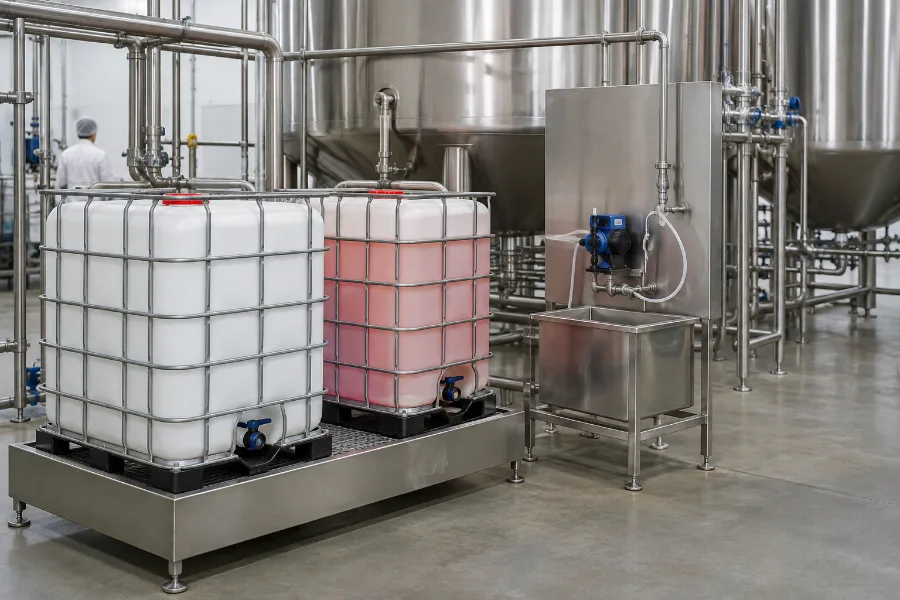
Circulating a cleaning solution through an installed exchanger, without removing or opening it, to dissolve deposits from the channels. On a brazed unit it is the only cleaning method available.
On the Bench and In the Line
From the Lower Connection
From the lower connection - , so air vents as the unit fills.
At Least 1.5 Times Normal Flow
At least 1.5 times normal flow - , preferably back-flushed.
The strainer is the number that actually matters
Every datasheet gives a maximum particle size, and it varies by frame - 0.7 mm on the B86, 0.8 mm on the B224, 1 mm on the B80. That figure sets the strainer mesh, and it is the single most effective thing you can specify.
Fitting a tight-channel frame behind an inadequate strainer is the commonest way these units are ruined, and it is entirely preventable at the design stage for the cost of a strainer.
For evaporator duty the guidance is tighter still: a filter below 1 mm, 16 mesh. On that duty the consequence of a blockage is not fouling but freezing, which is not recoverable.
What People Ask About Cleaning in Place
Watch two readings against their clean values: the pressure drop across each side at normal flow, and the approach temperture. Deposits narrow the channels, so drop climbs first. They also insulate the plate, so the leaving temperature drifts away from setpoint.
Clean when either has moved noticeably, not when the duty is lost. A light scale dissolves quickly. A heavy one closes channels off completely, and a closed channel gets no cleaning solution through it.
Isolation valves on all four connections, and a valved tee between each valve and the unit, large enough to take the cleaning pump at 1.5 times normal flow. With those in place a cleaning rig connects in minutes and can run in either direction.
The mistake seen most often is an exchanger piped hard into the system with no way in. The first cleaning then means draining the loop and cutting pipe, so it gets put off untill the unit is past saving. Adding the tees at installation costs very little by comparison. Also leave space below the lower connections to drain the solution out afterward.
Reverse the flow and clean again. If the pressure drop is still high after that, some channels are blocked solid or packed with debris that acid does not dissolve, and the unit will not recover. Replacement is the remaining option because a brazed pack cannot be opened.
Before the new unit goes in, deal with what killed the old one. Flush the system with the exchanger bypassed, and fit a strainer matched to the particle limit of the frame - 0.7 mm on a B86 is a finer requirement than 1 mm on a B80. Send us the nameplate and we will quote the same designation.
No. Phosphoric and oxalic acid dissolve mineral scale and rust. They do little against oil films, biological slime or silt, which need a detergent or alkaline cleaner suited to stainless steel and to the braze in that unit.
Find out what the deposit is before choosing the chemical. A sample from the strainer basket or from the first liquid drained out usually shows it. Whatever is used, rinse until the water leaving the unit matches the water going in. Cleaner left behind in a closed loop goes on working after the job is finished.
To a large extent. Fouling is slowest where channel velocity is high, so a selection that uses its allowable pressure drop stays cleaner than an oversized one drifting along at low velocity. Resist adding plates as a margin on a dirty or hard water duty.
Frame choice matters as well. Tight channels transfer heat well and tolerate less: the B86 limit is 0.7 mm against 1 mm for the B80. Where the water cannot be strained that finely, pick the frame with the larger particle limit. And put the scaling fluid on a circuit that can be isolated and back-flushed.
Related
SERIES • 18 TO 75 GPM
SWEP B80
The 526 mm standard - and the plate shared by the F80, P80 and V80 evaporators.
+ Learn More
SERIES • 200 TO 400 GPM
SWEP B224
Large ports for data center and district energy duty.
+ Learn More