Pharmaceutical and Pure Water

All-Stainless (SPS)

That single fact governs the whole selection. A copper-brazed unit on a pure water loop leaches copper into the stream and fails its conductivity specification, regardless of how well the plates themselves hold up.

The answer is copper-free construction throughout - stainless plates brazed with a stainless filler that SWEP describes as iron-based and formulated to mimic the plate composition.

All-Stainless (SPS). removes copper from the wetted path entirely. This is the construction for pure water, WFI loops and ammonia.

Nickel brazing (SN). is the other copper-free route, and it lifts the temperature ceiling to around 350 C as well.

Frame sizes exist at both ends. the small B8T for a laboratory skid, the B221 and B222 for plant-scale purified water systems.
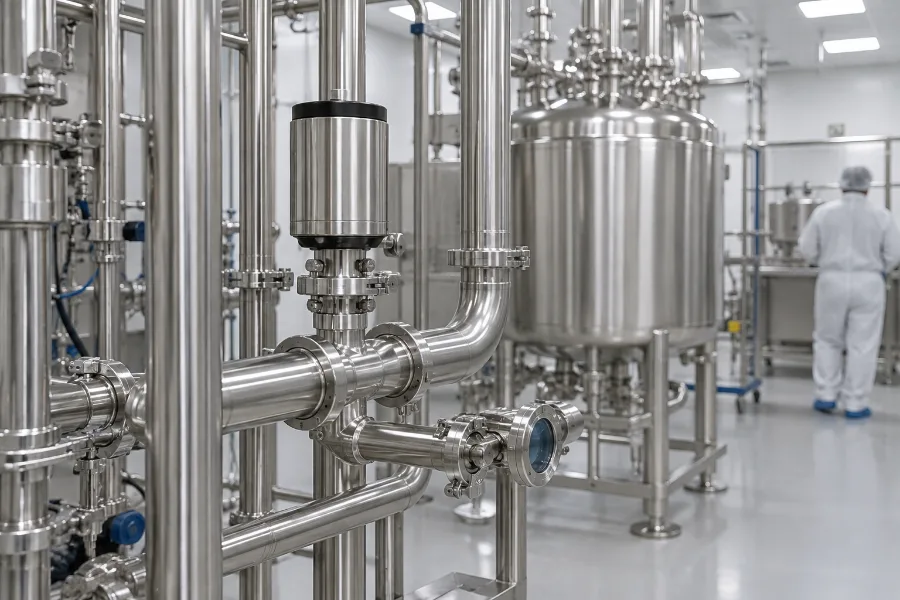

pharmaceutical and pure water with SWEP brazed plate heat exchangers
Deionized Water Deionized Water
Copper-Free Builds Copper-Free Builds

WFI Loops WFI Loops

Documentation Documentation

Pharmaceutical and Pure Water Selection

What decides the frame, and what to send with the enquiry.

Duty Inputs

  • Flows: both sides
  • Temperatures: in and out
  • Fluids: named, not described
  • Pressure drop: what is affordable

Typical Frames

Watch Items

  • Send the duty for a check
CODE PLATES BRAZE USE
SC 316/316L stainless Copper General duty
SPS 316 stainless Stainless - copper free Pure water, ammonia
SN Stainless Nickel alloy - copper free High temperature, ammonia
MC SMO 254 Copper Chloride-bearing water

Why copper-free is a specification, not an upgrade

On most duties the braze material is a detail.

A conductivity specification is a pass or fail. If the loop has to hold below a stated microsiemens figure, anything that adds ions to it is disqualifying - and a copper braze in contact with deionized water adds ions steadily rather than catastrophically. The unit works, the water does not.

The same reasoning makes All-Stainless the answer for ammonia, for a different reason: ammonia attacks copper directly. One construction solves two unrelated problems, which is why the copper-free frames turn up in both a refrigeration plant and a purified water room.

Where the duty is hot as well as pure, nickel brazing is worth asking about - it is copper-free and takes the temperature ceiling from roughly 185 C to around 350 C.


Frames for This Duty

SWEP B16 brazed plate heat exchanger - all-stainless construction - copper-free plates and brazing throughout
SWEP B221 brazed plate heat exchanger - all-stainless at large size - copper-free to 118 gpm
SWEP B222 brazed plate heat exchanger - the newest large all-stainless frame

Pharmaceutical and Pure Water - Asked and Answered

Because "stainless steel heat exchanger" describes the plates and says nothing about the braze. A standard SC unit has 316/316L plates and is, fairly, a stainless exchanger. It is also copper brazed, with copper wetted at every plate contact point.

This is the most common purchasing error on purified water skids. The unit passes its pressure test, and then conductivity drifts upward downstream of it and copper appears in the water analysis. Write the material code into the requisition - SPS or SN - rather than a plate alloy, and check that code on the nameplate at delivery.

Start with SPS unless temperature forces the question. Its filler is close to the plate alloy, so the water sees essentially one family of metal. A nickel braze is copper free too, but it puts a nickel alloy in the wetted path, and some water specifications limit nickel as well as copper. Read the specification for that before choosing.

SN earns its place when the same unit also has to run hot, since nickel carries the ceiling to around 350 C. The two codes are not offered on every frame, which often settles it. The plate and brazing materials page compares them.

Sometimes, but do not assume it. Copper-free construction is offered on particular frames, so the replacement may be a different frame from the one coming out - the SWEP B16, B221 and B222 are the All-Stainless frames named here, and the B8T is the nickel-brazed one.

A different frame means different port centres and possibly different connections, so the pipework may need altering. Send the nameplate of the existing unit and the duty. We select the copper-free frame that meets it and tell you what changes dimensionally before you commit.

Yes. In a brazed pack the filler forms the joint at every contact point between adjacent plates, so it is exposed in the channels of both circuits. There is no version with copper on the utility side only.

The utility side still affects the selection in other ways. It is normally the dirtier fluid, so it sets the strainer and the cleaning arrangement, and if it is chloride-bearing cooling water it raises a plate material question of its own.

That depends on what the validation protocol demands. A brazed unit cannot be opened, so the product-contact surfaces can never be seen after manufacture. Where the protocol requires visual inspection, a brazed unit is the wrong type of exchanger for that position, whatever its materials.

Where it fits well is utility and support duty: cooling or heating purified water on a loop that is monitored by conductivity, point-of-use coolers, and laboratory skids. Tell us with the enquiry which documents the project requires, such as material certificates, so we confirm what comes with the unit before it is ordered.

Quote Request Form:

Questions?

1-805-484-2992

Quotes - Engineering - Sales