
1-805-484-2992
Quotes - Engineering - SalesCONSTRUCTION AND RATINGS
Pressure Classes
Five classes cover the range. They trade pressure against temperature rather than forming a ranking, which is why reading them as a quality grade leads to the wrong frame.
Note that L is the lowest pressure class and the highest temperature - 14 bar at 225 C - because that is the shape hot oil duty needs.
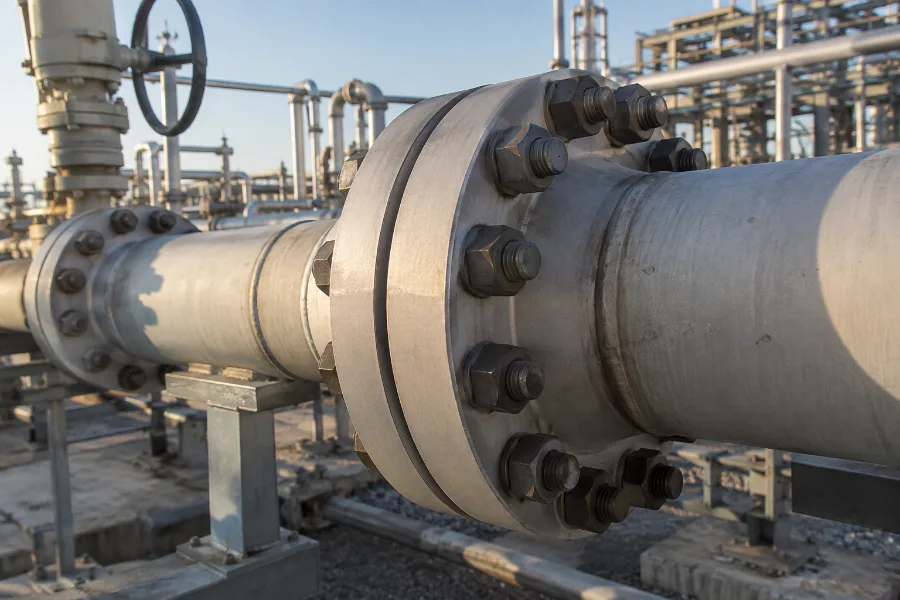
The final letter of a SWEP designation - L, S, M, H or U - naming the pressure and temperature category the unit is built to. It is a category; the rating stamped on the individual unit is the figure that governs.
| CLASS | RATING | STATED USE |
| L - Low | up to 14 bar at 225 C | Engine oil cooling, absorption chillers |
| S - Standard | 31 bar at 155 C | A wide variety of applications |
| M - Medium | up to 45 bar at 135 C, fatigue tested | Refrigerants such as R410A |
| H - High | 45 bar at 155 C | Common in the process industry |
| U - Ultra | 64 to 140 bar | CO2 as a refrigerant |
Materials and Ratings in Practice
L
L - up to 14 bar at 225 C.
S - 31 bar at 155 C.
M - up to 45 bar at 135 C, fatigue tested.
H
H - 45 bar at 155 C.
U - 64 to 140 bar, for CO2.
Why the refrigerant class is the fatigue-tested one
A refrigeration circuit cycles pressure constantly as the machine stages, defrosts and responds to load. A static pressure rating says nothing about how a brazed joint survives a few million of those cycles.
The M class carries fatigue qualification, and that is what makes it the refrigerant class. Specifying an H-class frame for a cycling refrigerant duty because it has a higher temperature rating is a misreading of what the two classes are for.
Approval-specific envelopes narrow things further: ASME covers -40 C to +150 C, CRN covers -196 C to +225 C, and US NSF/ANSI 61 is limited to 90 C. The binding limit is often one of those rather than the class.
Before You Specify
It is the single letter after the material code and before the connections. In B25THx30/1P-SC-M the class is M.
The letter that gets misread is the S in SC. SC is the material code, 316/316L plates with copper braze, and has nothing to do with S class. People also read the H in B25TH as high pressure; it is the plate type, an obtuse chevron. Only the letter in the last position before the connections is the class. The Model Number Guide walks through the whole string.
Going up in pressure is acceptable where the higher class is built on the same frame with the connections you need, but check the temperature at the same time. M is up to 45 bar at 135 C against 155 C for S, so a hot duty that S covers may not be covered by M.
Going the other way is never acceptable, and L is not a small step from S: it gives up pressure, to 14 bar, in exchange for temperature. Match the class on the nameplate unless there is a reason to change it, and tell us the reason.
The highest pressure that side of the exchanger can reach, which is seldom the operating pressure. On a refrigerant circuit that means the high-pressure cutout or relief setting, and standstill pressure when the plant is off and warm. On a water circuit it means pump dead-head plus static head, and the relief valve setting.
The common error is to size the class on gauge readings from a running machine. The unit then meets its real limit during a pressure test, a pump-down or a power failure.
No. A class is a build of a particular frame, and each frame is offered in the classes its plate and pack were designed and qualified for. The U class exists on a few frames built for CO2, among them the SWEP B18 and the B185; H class appears on frames such as the B12.
So the class can decide the frame, not the reverse. If the duty needs a class the obvious frame does not offer, the answer is a different frame with a different port layout, and that is worth knowing before the piping is drawn.
No. A class describes steady pressure at a temperature. Water hammer is a short spike well above anything on the gauge, repeated every time a valve slams shut, and it fatigues braze joints whatever the class letter says.
Even M, which is fatigue tested for refrigerant pressure cycling, is not a remedy for hammer. Fix the cause: slow-closing valves, solenoids placed so they do not close against a moving column of liquid, and piping supported so the connections carry no load.
Other class letters exist and turn up on real units. We do not publish a figure for them here, because a category figure that turns out to be wrong for your unit is worse than none.
Send us the nameplate, or a photograph of it. The stamped design pressure and temperature on that label are the rating of the unit in front of you, and they are what a replacement has to meet. We will confirm the rating and the matching current designation with the quote.
Related
SERIES • 18 TO 75 GPM
SWEP B18
U pressure class - 64 to 140 bar, built for transcritical CO2.
+ Learn More
SERIES • 75 TO 200 GPM
SWEP B185
U pressure class with asymmetric channels - the large CO2 frame.
+ Learn More
SERIES • 18 TO 75 GPM
SWEP B12
H pressure class with dual-over-two-pass capability in a compact frame.
+ Learn More