
1-805-484-2992
Quotes - Engineering - SalesSELECTING A UNIT
Glycol and
Fluid
Properties
Four properties matter: specific heat, which decides how much heat a given flow carries; viscosity, which decides pressure drop; density; and thermal conductivity.
Glycol moves specific heat down and viscosity up simultaneously, which is why a simple percentage derate applied to a water selection produces a frame that is both undersized and over its pressure drop budget.
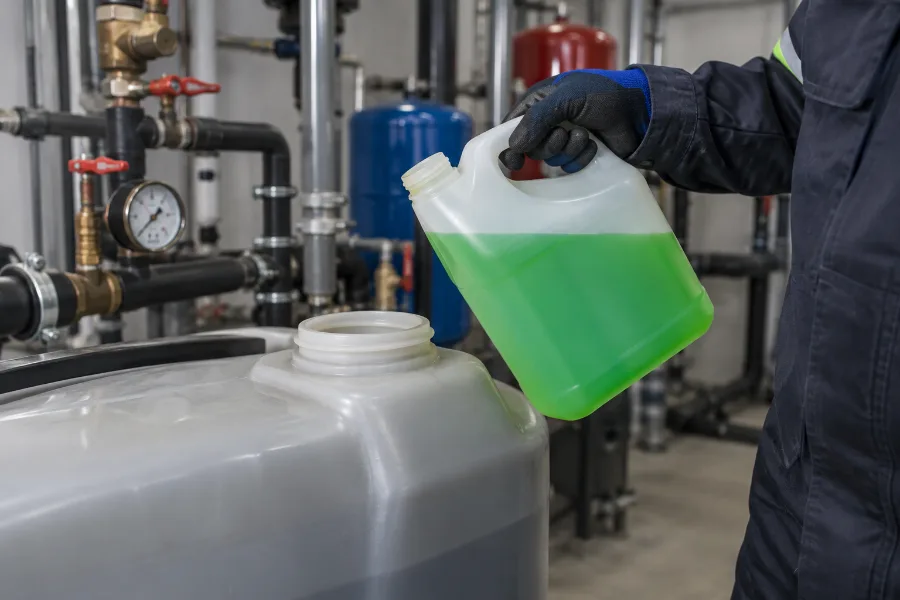
AHRI certification covers propylene and ethylene glycol as well as water, so the performance is published rather than estimated.
Request a QuoteThe loss of heat transfer and the gain in pressure drop when a glycol mix replaces water. The mix carries less heat per unit of flow and is more viscous, so the duty needs more surface and more pump head.
| FLUID | SPECIFIC HEAT | VISCOSITY | SELECTION EFFECT |
| Water | Baseline | Baseline | - |
| 30% propylene glycol | Lower | Higher | More surface, more head |
| 50% propylene glycol | Much lower | Much higher | Significantly more of both |
| Ethylene glycol | Lower | Higher than water, lower than propylene | Between |
| Lube oil | Much lower | Very high | Low-theta plates, L class |
Getting the Number Right
Certified Glycol Data Now Exists
Certified glycol data now exists. - AHRI certification covers propylene and ethylene glycol as well as water, so the performance is published rather than estimated.
Propylene and Ethylene Are Not Interchangeable
Propylene and ethylene are not interchangeable - in a calculation, even at the same concentration.
Why a percentage derate does not work
Specific heat falling means you need more flow to carry the same heat. Viscosity rising means that larger flow costs disproportionately more pressure drop. A single percentage applied to the duty addresses the first effect and ignores the second.
The result is a frame with roughly enough surface and far too much pressure drop - which then runs at reduced flow because the pump cannot deliver, at which point it no longer has enough surface either.
Both errors are invisible on paper and obvious at commissioning. Supplying the fluid type and concentration at quotation costs nothing and removes both.
Worth Knowing About Glycol and Fluid Properties
For the new fluid, probably yes - and so is the pump. The mix carries less heat per gallon than water did, so the same flow delivers less capacity, and it is more viscous, so the same pump delivers less flow through the same pipework and exchanger. The two losses stack.
Before replacing anything, measure the concentration. Systems are often dosed well beyond what freeze protection needs, and the table above shows how much further a 50 percent propylene mix moves both properties than a 30 percent one. Diluting to the concentration the site actually requires sometimes recovers enough to avoid new equipment.
At the operating temperatures of the duty, and then checked again at the coldest condition the loop will see. Glycol viscosity rises sharply as the fluid gets colder, so a mix that behaves almost like water in a warm heat recovery loop is a much thicker fluid in a low-temperature chiller loop at the same concentration.
The trap is a selection run at the design point only. It shows an acceptable pressure drop, and then the loop is started cold after a shutdown and the pump cannot establish flow.
It can, but it will not do what the original did. A nameplate records the unit, not the fluid it was selected for, so a like-for-like replacement on a glycol loop repeats a water selection.
The usual correction is more plates in the same frame. That adds surface and lowers pressure drop together, and the ports stay where they were, so the pipework on the connection face still lines up - the pack simply gets deeper. Check the clearance behind it. Send the old designation with the glycol type and concentration and we will quote the original alongside the corrected plate count.
Often. An H plate, with its obtuse chevron, gives the most heat transfer and the most pressure drop, and viscosity magnifies the pressure drop half of that bargain. On a weak mix at moderate temperature an H plate is usually still right. On a strong or cold mix, an M or L plate with more plates behind it frequently reaches the same duty inside the pump's head.
Yes - it costs capacity and pumping energy every hour the system runs. Each step up in concentration lowers specific heat and raises viscosity, so a mix stronger than necessary needs more flow, more head and more plate surface for the same duty. Going from 30 to 50 percent propylene glycol is a significant change in all three, not a safety margin that comes free.
Because a viscous fluid drops out of turbulent flow sooner than water does. A plate pack depends on turbulence in the channels for its heat transfer coefficient. As a variable-speed loop turns down, a glycol mix reaches the point where the flow goes smooth and layered much earlier than water would, and the coefficient falls away faster than the flow.
It shows as a unit that meets its duty at full load and cannot hold leaving temperature at part load, when it ought to have surplus surface. Give the minimum flow with the duty so the selection is checked at turndown as well as at the design point.
Related

SERIES • 18 TO 75 GPM
SWEP B80
The 526 mm standard - and the plate shared by the F80, P80 and V80 evaporators.
+ Learn More