Ammonia Plant

SPS - All-Stainless

The answer is copper-free construction: All-Stainless frames, where stainless plates are brazed with a stainless filler, or nickel brazing where the temperature also needs lifting.

Until the large All-Stainless frames existed, plant-scale ammonia duty went to welded or gasketed equipment by default. The B221 and B222 are what closed that gap.

SPS - All-Stainless. No copper anywhere in the wetted path. The default for ammonia.

SN - nickel brazed. Also copper-free, and takes the ceiling from roughly 185 C to around 350 C.

Frame sizes. run from the small B8T to the B221 and B222 at plant scale.
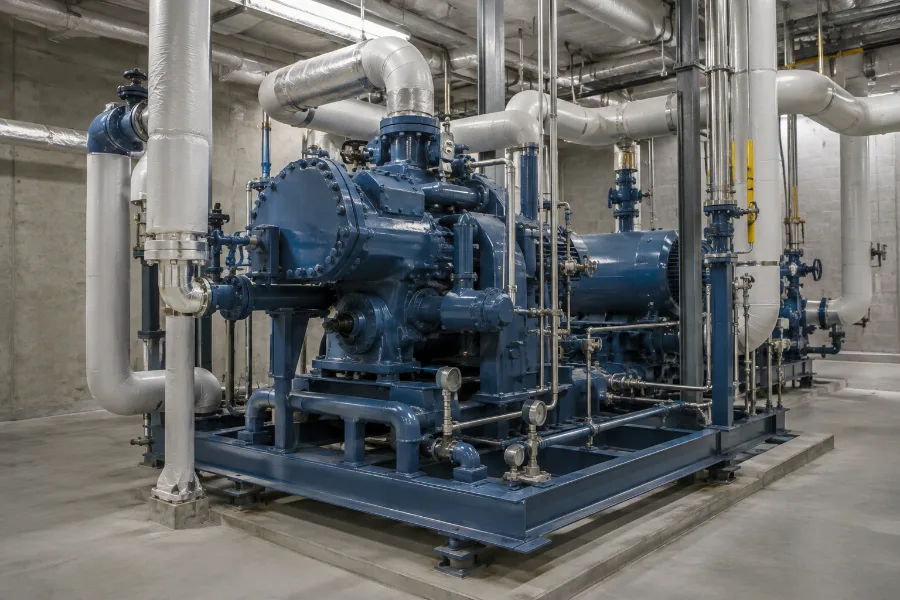
ammonia plant with SWEP brazed plate heat exchangers
Copper-Free Copper-Free
Nickel Braze Nickel Braze

Plant Safety Plant Safety

Charge Reduction Charge Reduction

Ammonia Plant Selection

What decides the frame, and what to send with the enquiry.

Duty Inputs

  • Flows: both sides
  • Temperatures: in and out
  • Fluids: named, not described
  • Pressure drop: what is affordable

Typical Frames

Watch Items

  • Send the duty for a check
CODE BRAZE CEILING NOTE
SPS Stainless - copper free Plate-limited The default for ammonia
SN Nickel alloy - copper free around 350 C Where the duty is hot as well
SC Copper around 185 C Not for ammonia

Specifying an ammonia duty without a surprise

Ammonia jobs go wrong in two predictable ways.

The first is a copper-brazed unit reaching site. It happens because the frame size and the pressure class were specified carefully and the material code was left to default. On an ammonia line the material code is the specification - check that SPS or SN appears in the string before the order goes out.

The second is temperature. Ammonia systems often run hotter on the discharge side than the selection assumed, and a copper braze would have been the limiting component anyway. Where discharge temperatures are high, nickel brazing buys headroom that stainless brazing does not.

Neither problem is expensive to avoid at quotation. Both are expensive to discover at commissioning.


Frames for This Duty

SWEP B16 brazed plate heat exchanger - all-stainless construction - copper-free plates and brazing throughout
SWEP B221 brazed plate heat exchanger - all-stainless at large size - copper-free to 118 gpm
SWEP B222 brazed plate heat exchanger - the newest large all-stainless frame

Practical Questions on Ammonia Plant

The material code first: the designation must carry SPS or SN. Then the pressure class and the code stamp the plant's jurisdiction requires, and the connection type, since ammonia pipework is normally welded steel and the exchanger has to arrive with connections that suit it.

If the unit being replaced is a gasketed or welded exchanger, say so. A brazed pack cannot be opened for inspection or mechanical cleaning, and on some plants that changes the maintenence routine enough to matter. We would rather raise it at the quote than after delivery.

Describing the secondary fluid as "brine" and leaving it there. All the attention goes to keeping copper away from the ammonia, and the other circuit gets a one-word description.

The plates see both fluids. A glycol solution is ordinary duty for 316 plates, but a chloride-bearing brine pits 316, and the damage appears as pinhole leaks between the circuits some time after commissioning. Name the secondary fluid by its chemistry and concentration so the plate material is chosen for both sides of the exchanger at once.

Treat it as a limit, not a target. A maximum flow is set by what the ports can pass, and a selection normally lands well inside it once the allowable pressure drop on the secondary side is taken into account.

Where the plant duty is larger than one pack can carry, units are piped in paralell. That also gives the plant a degree of redundancy and keeps each pack at a manageable size. Send the capacity, the evaporating or condensing temperature and both secondary-side temperatures and we will set the frame, plate count and number of units.

Orientation, oil and freezing. A two-phase duty needs the pack mounted vertically so liquid and vapor distribute and separate as intended.

Oil carried over from the compressors tends to collect at the low points of an ammonia system, so the piping around the evaporator needs a way to drain it; oil coating the plates costs capacity that no amount of surface gets back. On a water or weak-glycol chiller, add flow proving and freeze protection. Water freezing in the channels can split a pack, and on this duty that puts ammonia into the secondary loop.

Quote Request Form:

Questions?

1-805-484-2992

Quotes - Engineering - Sales